-
Somebody once stated, "they‘d rather be lucky than good any day.” I‘ve applied this bit of wisdom to poker on more than one occasion, but recently I‘ve learned it applies to blogging as well. Not 24 hours after I posted my blog on organically grow/produced foods, in which I concluded that eating farm fresh foods is what’s actually important, Dana Viktor sent me this guest piece, which serves as the perfect follow up.
Dana Viktor is the senior researcher and writer for duedatecalculator.org. Her most recent accomplishments include graduating from Ohio State University with a degree in communications and sociology. Her current focus for the site involves pregnant women.
-
5 Reasons to Eat Local, by Dana Viktor
The local foods movement has grown in the last several years, as more and more people are looking to eat healthy food and to be more responsible global citizens by reducing their consumption of natural resources. If you still aren't sure what this movement is all about, consider these 5 reasons to eat more locally sourced food as a means of eating healthier and choosing a more environmentally friendly lifestyle:
Fresh Food
When your food is grown locally, it does not need to be infused with preservatives to keep it from going bad too quickly -- or with artificial colors or flavors to mask its lack of freshness. Food that is locally grown can be produced without all these chemicals, ensuring that you are getting a fresher, healthier product.
Food Grown in Season
If you live in Wisconsin, you shouldn't be able to buy strawberries in December. If you don't know why that is, chances are you have been buying your produce from a large chain grocery store where the produce is shipped in from around the world.
When food is made available out of season, it is either shipped in from half way across the globe where it can be grown, using a vast amount of natural resources for packaging and transportation, or it is grown using artificial methods like chemicals. Neither are good for you or the environment.
Relationship with the Farmer
When you purchase your food from local sources, you have the opportunity to develop a relationship with the farmer who grows it. You can either purchase your produce directly from the farmer at local markets, or you can take the time to visit the farmer to get to know about the facilities and methods used to grow the food.
Either way, forming relationships with local farmers helps you to ensure that your food comes from a reliable source, and that it is grown in a healthy and environmentally responsible manner.
Stronger Local Economy
Why buy from Guatemala what you can buy from across town? When you buy your food from local sources, you are supporting jobs in your local economy. You are supporting the farmer who grows it, the workers who harvest it and prepare it for sale, the vendors who manage the markets where the food is grown, and so on.
If you were to purchase that same produce from Guatemala -- or any other place where your food is grown -- you would be investing in jobs and the economy in those communities instead of your own.
Fewer Resources
When you buy food from other states and other countries, it doesn't magically teleport itself to your table. It has to be packaged for freshness and shipped to your local markets. Every step of that process consumes natural resources such as trees for packaging (or worse, chemicals), coal for energy, and gas for transportation -- to name only a few.
Buying foods locally reduces the need for many steps in this process, helping to reduce the number of resources that are consumed. The fewer resources are consumed, the better the health of our environment.
Eating local is not just a trendy thing to do. It helps you to eat healthier food, to support your local economy and farmers, and to reduce your consumption of natural resources. Not only are you making a good choice for your body, but you're also making a good choice for the environment.
Do you buy your foods local when you can? Tell us why you started buying local in the comments!
-
I am not a professional chef, nor have I been classically trained in the field of cuisine. I AM, however, a writer and a well read food & wine enthusiast, who lives to eat and knows what he likes. In this blog, you'll read my views on cheese, wine, restaurants, cooking, food trends, and more.
Wednesday, October 24, 2012


Tuesday, October 16, 2012
Organically Grown/Produced Foods -- Are They Worth The Price?
-
I prefer the term "Organically Grown/Produced Foods," since the term Organic Foods can, in scientific circles, can refer to any carbon based food which was alive at some point. There's no such thing as an inorganic fruit or vegetable, unless it's made of plastic.
Season of mists and mellow fruitfulness! Close bosom-friend of the maturing sun; Conspiring with him how to load and bless with fruit the vines that round the thatch-eaves run; To bend with apples the moss’d cottage trees, and fill all fruit with ripeness to the core. ~ John Keats
The weather has finally turned cool & damp, here in the Northwest, reminding us that we are indeed in the midst of fall. Traditionally, autumn is thought of as the season of the harvest. Being a season ripe with fresh fruits & vegetables, and in some households wild game, I began thinking about what I eat.
OK, there's not a day that goes by that I don't think about the next; delectable morsel I want to savor, restaurant I want to visit, or recipe I want to try. Contrary to my typical gourmet fantasizing and wish list making though, the fall bounty began to make me think about the actual; vitamins, minerals, additives, chemicals, etc..; I put into my body when I eat.
For years I've been told, by various sources, that if I truly cared about my health, I should buy:
It's easy to see that unless you have a diet heavy in oatmeal & brown rice, the purchase of organically grown/produced foods are going to significantly increase your grocery bill. Thus, the question becomes, "Are organically grown/produced foods worth the higher prices?"
I wanted to ask my loyal readers that very question, so I sent the following survey to recipients of my newletter.
-
1. How important is it to you to eat organically grown/produced foods?
Crucial, I will ONLY eat organically grown/produced foods.
Somewhat important, I'll buy it when I can afford it.
I don't care, I'll eat whatever tastes the best and/or costs the least.
-
2. If you answered "Crucial" or "Somewhat important" on question 1, please indicate the reason(s) for said answer below. Mark all that apply.
Organically grown/produced foods are healthier (contain more vitamins and nutrients) than typically mass produced foods.
Organically grown/produced fruits & vegetables are healthier (contain fewer pesticides) than typically mass produced fruits & vegetables.
Organically grown/produced meats & poultry are healthier (contain fewer hormones) than typically mass produced meats & poultry.
Organically grown/produced foods taste better than typically mass produced foods.
Organically grown/produced foods are better for the environment/ecology than typically mass produced foods.
Organically grown/produced foods make me feel closer to the Earth/God/Universe spiritually.
I want to support small family farms, rather than corporate farms.
Other, please specify.
-
Of those who responded, one third of participants marked, "I don't care, I'll eat whatever tastes the best and/or costs the least," and two thirds selected, "Somewhat important, I'll buy it when I can afford it." Given the media attention and hype surrounding organically grown/produced foods, I was surprised that no one said that purchase and consumption of these foods is crucial.
Among those who said purchase and consumption of Organically Grown/Produced Foods was somewhat important, I'll buy it when they can afford it, two reasons were given 100% of the time.
First, the somewhats indicated they bought organically grown/produced foods when they can afford it because, "Organically grown/produced foods are healthier (contain more vitamins and nutrients) than typically mass produced foods." Yet, a recently published study in The Annals of Internal Medicine found no evidence of health benefits from organically grown/produced foods. They could find no significant difference in vitamin & nutrient levels or allergen levels.
The notable exception to this non-finding was in certain strains of tomatoes which exhibited higher than normal levels of antioxidants after having been grown organically for ten years. However, these higher than normal levels of antioxidants could not be replicated in produce across the board.
The other reason the somewhats always chose was that they wanted "to support small family farms, rather than corporate farms." Nonetheless, according to the July 7th, 2012 article, "Organic Food Purists Worry About Big Companies’ Influence," in The New York Times, for the last ten years fortune 500 food companies such as Coca-Cola, Cargill, ConAgra, General Mills, Kraft Foods and M&M Mars have bought up most of the nation’s, once mom & pop, organically grown food farms.
Consumers who purchase such foods in order to support small manufacturers are in a similar boat. Organically produced food brands Bear Naked, Wholesome & Hearty, and Kashi all belong to the breakfast cereal kingpin Kellogg's. Likewise, the organically produced health drink Naked Juice is brought to you by the makers of of Pepsi Cola and Fritos Corn Chips, PepsiCo.
Slightly fewer participants were of the belief that "Organically grown/produced fruits & vegetables are healthier (contain fewer pesticides) than typically mass produced fruits & vegetables." However, the same study which found no significant difference in vitamin levels found no evidence of decreased danger to consumers from the naturally derived pesticides which are used to maintain organically grown crops, since "the vast majority of conventionally grown foods do not exceed allowable limits of pesticide residue set by federal regulations." It should also be noted that "naturally derived pesticides" are still pesticides, or poisons, which can be found, at legally low levels, on organically grown/produced fruits & vegetables.
The only other reason reported was the subjective belief that "Organically grown/produced foods taste better than typically mass produced foods." I can understand why people believe this. Typical grocery store produce has been bread for mass production at the expense of flavor. In fact, grocery store produce reminds me of the 1967 Star Trek episode, The Squire of Gothos, in which a naive alien replicated human foods in appearance, but without any taste or aroma whatsoever.
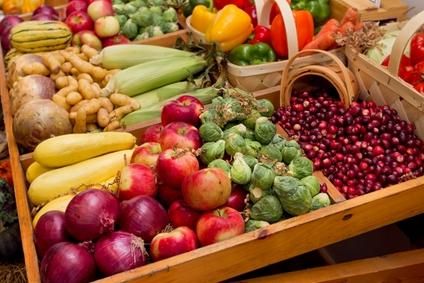
That's why I go to Farmers' Markets, when I can, to buy farm fresh produce. In my opinion, farm fresh food is where the flavor is. Frankly, when I can get 10 ears of tender sweet corn for a dollar I'm going to be all over that, whether it's organically grown, or not. The same goes for locally grown farm fresh tomatoes, peppers, onions, lettuce, carrots, celery, berries, pears, plumbs.........
Again, it's just my opinion, but my palette can't tell the difference between organically grown/produced food and farm fresh food. That being the case, and with no empirical evidence of health benefits, or benefits to small businesses/farms, I have to question the wisdom of shelling out 2 to 5 times more money for organically grown/produced foods.
OK, if eating such foods makes you feel closer to nature or Gaia or God, and you can afford the extra expense, go for it. I'm simply saying that when people are clipping coupons to make ends meet I can't see a reason for them to feel pressure to buy expensive organically grown/produced foods to feed their families. I'm not going to worry about it.
-
The weather has finally turned cool & damp, here in the Northwest, reminding us that we are indeed in the midst of fall. Traditionally, autumn is thought of as the season of the harvest. Being a season ripe with fresh fruits & vegetables, and in some households wild game, I began thinking about what I eat.
OK, there's not a day that goes by that I don't think about the next; delectable morsel I want to savor, restaurant I want to visit, or recipe I want to try. Contrary to my typical gourmet fantasizing and wish list making though, the fall bounty began to make me think about the actual; vitamins, minerals, additives, chemicals, etc..; I put into my body when I eat.
For years I've been told, by various sources, that if I truly cared about my health, I should buy:
- Produce grown with pesticides derived from natural sources,
- Food which has no synthetic ingredients or containing a minimum of 95% Organically Grown/Produced ingredients, and
- Meat, eggs, poultry, and dairy coming from animals that have never received antibiotics or growth hormones.
| Food Product | Average Price Of Non-organically Grown/Produced Version | Average Price Of Organically Grown/Produced Version | Price Difference As A Percentage |
Dairy and Eggs | |||
Yogurt | $0.06/oz. | $0.13/oz. | 117% |
Milk | $3.79/gal. | $7.36/gal. | 94% |
Cheddar Cheese | $0.28/oz. | $0.57/oz. | 104% |
Eggs | $2.59/doz. | $4.18/doz. | 61% |
Grain Products | |||
Oatmeal | $0.17/oz. | $0.16/oz. | -6% |
Cereal | $0.23/oz. | $0.25/oz. | 9% |
Brown Rice | $0.10/oz. | $0.09/oz. | -10% |
Bread | $0.14/oz. | $0.17/oz. | 21% |
Produce | |||
Romaine Lettuce | $1.78/head | $3.54/head | 99% |
Carrots | $0.77/lb. | $1.51/lb. | 96% |
Bananas | $0.57/lb. | $0.89/lb. | 56% |
Tomatoes | $2.82/lb. | $4.05/lb. | 44% |
Red Peppers | $2.76/lb. | $5.89/lb. | 113% |
Yellow Onions | $0.93/lb. | $1.57/lb. | 69% |
Apples | $1.57/lb. | $2.34/lb. | 49% |
Protein Products | |||
Peanut Butter | $0.12/oz. | $0.27/oz. | 125% |
Tofu | $0.15/oz. | $0.19/oz. | 27% |
Chicken Breasts | $3.46/lb. | $5.07/lb. | 47% |
Ground Beef | $3.58/lb. | $8.39/lb. | 134% |
Other Products | |||
Canned Tomatoes | $0.06/oz. | $0.14/oz. | 133% |
Grape Juice | $0.05/oz | $0.07/oz | 40% |
It's easy to see that unless you have a diet heavy in oatmeal & brown rice, the purchase of organically grown/produced foods are going to significantly increase your grocery bill. Thus, the question becomes, "Are organically grown/produced foods worth the higher prices?"
I wanted to ask my loyal readers that very question, so I sent the following survey to recipients of my newletter.
-
1. How important is it to you to eat organically grown/produced foods?
Crucial, I will ONLY eat organically grown/produced foods.
Somewhat important, I'll buy it when I can afford it.
I don't care, I'll eat whatever tastes the best and/or costs the least.
-
2. If you answered "Crucial" or "Somewhat important" on question 1, please indicate the reason(s) for said answer below. Mark all that apply.
Organically grown/produced foods are healthier (contain more vitamins and nutrients) than typically mass produced foods.
Organically grown/produced fruits & vegetables are healthier (contain fewer pesticides) than typically mass produced fruits & vegetables.
Organically grown/produced meats & poultry are healthier (contain fewer hormones) than typically mass produced meats & poultry.
Organically grown/produced foods taste better than typically mass produced foods.
Organically grown/produced foods are better for the environment/ecology than typically mass produced foods.
Organically grown/produced foods make me feel closer to the Earth/God/Universe spiritually.
I want to support small family farms, rather than corporate farms.
Other, please specify.
-
Of those who responded, one third of participants marked, "I don't care, I'll eat whatever tastes the best and/or costs the least," and two thirds selected, "Somewhat important, I'll buy it when I can afford it." Given the media attention and hype surrounding organically grown/produced foods, I was surprised that no one said that purchase and consumption of these foods is crucial.
Among those who said purchase and consumption of Organically Grown/Produced Foods was somewhat important, I'll buy it when they can afford it, two reasons were given 100% of the time.
First, the somewhats indicated they bought organically grown/produced foods when they can afford it because, "Organically grown/produced foods are healthier (contain more vitamins and nutrients) than typically mass produced foods." Yet, a recently published study in The Annals of Internal Medicine found no evidence of health benefits from organically grown/produced foods. They could find no significant difference in vitamin & nutrient levels or allergen levels.
The notable exception to this non-finding was in certain strains of tomatoes which exhibited higher than normal levels of antioxidants after having been grown organically for ten years. However, these higher than normal levels of antioxidants could not be replicated in produce across the board.
The other reason the somewhats always chose was that they wanted "to support small family farms, rather than corporate farms." Nonetheless, according to the July 7th, 2012 article, "Organic Food Purists Worry About Big Companies’ Influence," in The New York Times, for the last ten years fortune 500 food companies such as Coca-Cola, Cargill, ConAgra, General Mills, Kraft Foods and M&M Mars have bought up most of the nation’s, once mom & pop, organically grown food farms.
Consumers who purchase such foods in order to support small manufacturers are in a similar boat. Organically produced food brands Bear Naked, Wholesome & Hearty, and Kashi all belong to the breakfast cereal kingpin Kellogg's. Likewise, the organically produced health drink Naked Juice is brought to you by the makers of of Pepsi Cola and Fritos Corn Chips, PepsiCo.
Slightly fewer participants were of the belief that "Organically grown/produced fruits & vegetables are healthier (contain fewer pesticides) than typically mass produced fruits & vegetables." However, the same study which found no significant difference in vitamin levels found no evidence of decreased danger to consumers from the naturally derived pesticides which are used to maintain organically grown crops, since "the vast majority of conventionally grown foods do not exceed allowable limits of pesticide residue set by federal regulations." It should also be noted that "naturally derived pesticides" are still pesticides, or poisons, which can be found, at legally low levels, on organically grown/produced fruits & vegetables.
The only other reason reported was the subjective belief that "Organically grown/produced foods taste better than typically mass produced foods." I can understand why people believe this. Typical grocery store produce has been bread for mass production at the expense of flavor. In fact, grocery store produce reminds me of the 1967 Star Trek episode, The Squire of Gothos, in which a naive alien replicated human foods in appearance, but without any taste or aroma whatsoever.
That's why I go to Farmers' Markets, when I can, to buy farm fresh produce. In my opinion, farm fresh food is where the flavor is. Frankly, when I can get 10 ears of tender sweet corn for a dollar I'm going to be all over that, whether it's organically grown, or not. The same goes for locally grown farm fresh tomatoes, peppers, onions, lettuce, carrots, celery, berries, pears, plumbs.........
Again, it's just my opinion, but my palette can't tell the difference between organically grown/produced food and farm fresh food. That being the case, and with no empirical evidence of health benefits, or benefits to small businesses/farms, I have to question the wisdom of shelling out 2 to 5 times more money for organically grown/produced foods.
OK, if eating such foods makes you feel closer to nature or Gaia or God, and you can afford the extra expense, go for it. I'm simply saying that when people are clipping coupons to make ends meet I can't see a reason for them to feel pressure to buy expensive organically grown/produced foods to feed their families. I'm not going to worry about it.
-
Subscribe to:
Posts (Atom)