Monday, January 21, 2013

Buying Seafood

-
A few years ago I wrote a piece on the fraudulent mislabeling of seafood, and how it was endangering people's health.  What dropped my jaw recently, is the idea that even when we know which species we're buying, we may still be buying substances that could make us sick.

Reportedly, 86% of America's seafood is imported, half of which is  raised on factory farms.  89% of these farm factory imports come from Asian countries.  This would be fine, except for the fact that much of what's being imported from these don't meet American health standards.  Unfortunately, the FDA's testing procedures haven't caught up to the times, which still require testing of only 2% of seafood imports per year.

Below are just a few frightening examples of what's coming through customs, according to a (10/23/12) article from The Business Insider.
  • Tilapia in China's fish farms, are fed pig and goose manure — even though it contains salmonella and makes the Tilapia "more susceptible to disease." 
  • In Vietnam, farmed shrimp bound for the US market are kept fresh with heaps of ice made from tap water that teems with pathogenic bacteria.  
  • Bloomberg also notes that at the same company "there’s trash on the floor, and flies crawl over baskets of processed shrimp stacked in an unchilled room." 
  • In May, ABC News bought 30 samples of imported farmed shrimp from across the country and had them tested for antibiotic traces. The result: Three of the samples contained detectable levels of antibiotics unapproved for use in the US. 
  • According to a recent study by the Centers for Disease Control and Prevention, a quarter of the food-borne illness outbreaks caused by imported food from 2005 to 2010 involved seafood — more than any other food commodity.
So, what can you do to protect yourself and your family?  The best thing you can do is to eat seafood from clean sustainable sources.  In a nutshell, fish & shellfish harvested from clean sustainable sources will be healthier when alive, thus will be healthier for us when we consume them.

Then the question becomes, how does a buyer know which seafood is sustainable?  Well, there are a few ways.  Like I said a few years ago, find a grocer you trust.  I can't stress this enough.  Any TV commercial can make any store chain seem like part of your family, but do your research.

Has your store made a public commitment to  using only sustainable seafood the way Costco, Safeway, & Whole Foods have?  If not, does your store at least promote sustainable seafood by clearly labeling your choices with a color code such as the following seafood quality & sustainability key, used by The Blue Ocean Institute?
Seafood Quality & Sustainability Key:

MercuryThese fish contain levels of mercury or PCBs that may pose a health risk to adults and children. Please refer to http://www.edf.org/seafood for more details.

RedSpecies has a combination of problems such as overfishing, high by catch, and poor management; or farming methods have serious environmental impacts.

YellowSome problems exist with this species' status or catch/farming methods, or information is insufficient for evaluating.

GreenSpecies is relatively abundant, and fishing/farming methods cause little damage to habitat and other wildlife.

CertifiedA fishery targeting this species has been certified as sustainable and well managed to the Marine Stewardship Council's environmental standard. Learn more at http://www.msc.org.
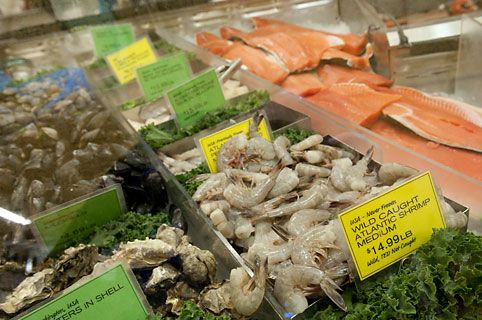
labeled seafoodMy favorite specialty grocer labels their seafood with a similar color-based system (I think they combined the green and blue categories into a single green category).  Yes, occasionally they sell seafood from the unsustainable red category, but those few items are always labeled with a BIG RED DANGER CARD, so buyers know exactly what they're getting and where it's coming from.

My general discount grocer doesn't use such a system.  Thus, I've been known to buy my freezables, potato chips, V8, etc..., at my general discount grocer a stop by my favorite specialty grocer to pick up wild Alaskan Coho Salmon filets for that night's dinner.  Yes, the fish costs more, sometimes 4 times more, that way.  However, buying seafood at such conscientious stores gives me the peace of mind which comes with knowing what I'm buying & putting into my body.

Now, if reality requires you to do all your shopping at a general discount grocer, where low price is THE bottom line, there are still some things you can do to arm yourself. Greenpeace published this 52 page pdf ranking the top 20 national grocers based on the strength and responsible implementation of their seafood policy.

On page 7, I was surprised to find Safeway ranked, above Whole Foods, as #1.  I was also surprised to see Trader Joe's, Costco (even with their aforementioned pledge), and Kroger (locally Fred Meyer's) ranked relatively low while Target, of all places, was ranked 5th.

 Of course, these rankings tell shoppers nothing about local chains such as WinCo, Albertsons, etc... If you find Safeway to be on the spendy side, and you frequent a local grocer, you can still prepare to make an informed purchase.   Many environmental watch dog groups, such as Monterey Bay Aquarium's Seafood Watch, publish and distribute free seafood sustainability charts, like the one below, to consumers and restauranteurs.

BEST CHOICES
GOOD ALTERNATIVES
AVOID

Abalone (U.S. Farmed)

Arctic Char (U.S., Canada, Norway, Iceland; Farmed in Recirculating Systems)

Barramundi (U.S. Farmed in Fully Recirculating Systems)

Capelin (Iceland, Wild-caught)

Catfish (U.S. Farmed)

Clams (Worldwide, Farmed)

Clams, Softshell/Steamers (U.S. Atlantic, Wild-caught)

Cobia (U.S. Farmed)

Cod, Atlantic (Hook-and-line from Iceland and Northeast Arctic (by Norway, Russia))

Cod, Pacific (U.S. Bottom Longline, Jig and Trap)

Crab, Dungeness (California, Oregon and Washington, Trap)

Crab, Kona (Australia, Wild-caught)

Crab, Stone (U.S. Atlantic, U.S. Gulf of Mexico, Trap)

Crawfish/Crayfish (U.S. Farmed)

Croaker, Atlantic (U.S. Non-trawl)

Barramundi (Australia, Farmed in Fully Recirculating Systems)

Basa (Imported, Farmed)

Black Drum (Trotline from U.S. Gulf of Mexico)

Black Sea Bass (U.S. Mid-Atlantic, Wild-caught)

Bluefish (U.S. Atlantic, Wild-caught)

Bluenose (Southern Pacific, Wild-caught)

Capelin (Canada, Wild-caught)

Caviar, Sturgeon (U.S. Farmed)

Clams, Atlantic Surf (U.S. Atlantic, Wild-caught)

Clams, Hard (U.S. Atlantic, Wild-caught)

Clams, Ocean Quahog (U.S. Atlantic, Wild-caught)

Cod, Atlantic (Bottom Gillnet, Bottom Longline, Bottom Trawl & Danish Seine from Iceland & Northeast Arctic)

Cod, Atlantic (Hook & line from U.S. Gulf of Maine)

Barramundi (Imported, Farmed in Open Systems)

Caviar, Paddlefish (U.S. Wild-caught)

Caviar, Sturgeon (Imported, Wild-caught)

Chilean Seabass (Southern Ocean, Wild-caught)

Cobia (Imported, Farmed)

Cod, Atlantic (Trawl-caught from Canadian and U.S. Atlantic)

Cod, Pacific (Imported, Wild-caught)

Conch, Queen (Worldwide, Wild-caught)

Corvina, Gulf (Gulf of California, Wild-caught)

Crab, King (Russia, Trap)

Crawfish/Crayfish (Imported, Farmed)

Dab, Common (Danish Seine from Iceland)

Dogfish, Spiny (Wild-caught from Canadian Atlantic and U.S.)

Eel, Freshwater (Worldwide, Farmed)


These columns are longer than what is shown here, but you can download a COMPLETE printable PDF version of the Seafood Buyer's Guide from Monterey Bay Aquarium's Seafood Watch.

Even stores that don't label health & sustainability  levels, must, by law, label the species and source (Tuna, Skipjack [Worldwide, Troll/Pole]).  Therefore, once you have your printed copy, it's perfectly fine to take it shopping to remind yourself which products are from healthy sustainable sources by matching the species and source from the product in the counter tot the appropriate column on the chart.   Assuming they label their products honestly, you should be able to make a healthy well informed purchase.
-

Monday, January 7, 2013

Celebrate National Hot Pastrami Sandwich Day - 01/14/13

-
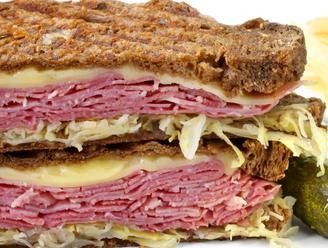
PhotobucketAccording to Dictionary.com, Pastrami is defined as
-
pas·tra·mi

[puh-strah-mee] 

noun

a brisket of beef that has been cured in a mixture of garlic, peppercorns, sugar, coriander seeds, etc., then smoked before cooking.
 -
This is a good definition, as far as it goes.  Most serious eaters will tell you though, that what gives Pastrami its signature flavor, in addition to the spices & smoke, is the 1/8 of an inch to 1/4 of an inch layer of fat running through the meat.

Yes, there are low fat Chicken & Turkey Pastramis, which are OK alternatives for the health & weight conscious among us.  Still, they're not quite the same as the fatty spicy salty kosher Beef treat.  Thus, instead of trying to work a low fat version into my diet, on the 14th, I plan to fully satisfy myself by splurging one time on the real McCoy.

Interestingly enough, Pastrami probably wasn't originally a cut of beef at all.  Many historians believe the first Pastrami was produced around 1200 A.D., in Turkey, as a brined pork product, seasoned with cloves, allspice, mustard, and paprika. As the Ottoman Empire expanded from Turkey, and the Middle East, into Europe, Pastrami was discovered by the Jews who substituted beef for pork in order to adhere to kosher dietary laws.

Beef Pastrami became popular in European regions with large Jewish populations, such as Romania and Armenia.  During this time, the meat could be found in such kosher dishes as Pastrami KnishesCelery Root Latkes, etc...  Fast forward a few hundred years, and Pastrami eventually arrived with Jewish immigrants in New York City, where it became a popular, almost city symbolic, meat.

There are basically two kinds of Beef Pastrami, dry cured & wet curedWet Cured Pastrami is immersed in, or more commonly coated with, a spiced brine, and the meat is smoked for a few hours, or a day, then is injected with liquid smoke before resting.  This method is easiest for mass production, but reportedly lacks depth of flavor.

Dry cured Pastrami is generally thought of as the superior of the two types, because dry curing draws moisture from the meat, intensifying the flavors of the spices & smoke.  Essentially, the meat is rubbed multiple times over the course of days, or weeks, with a spice blend.  Then the Pastrami is slow smoked with hot smoke.

You can find complete directions on how to dry cure your own Pastrami here.  Personally though, I'm probably never going to use, or be able to store, a brisket's worth of Pastrami, unless I'm giving the stuff away as gifts.  Thus, for my money, I'd rather find a grocer, or restauranteur, I trust, and partake of the artisan crafted goods.

For reasons largely unknown, January 14th  is  National Hot Pastrami Sandwich Day.  As I said I plan to go off my diet a bit and treat myself to celebrate.  Below are a few recipes which I may pick from to do just that.
-
"Anytime a person goes into a delicatessen and orders a Pastrami on white bread, somewhere a Jew dies." ~ Milton Berle

Hot Pastrami Sandwiches
Makes 8 sandwiches.

Ingredients
  • 2 lbs cooked and thinly sliced Beef Pastrami
  • 8 slices Havarti Cheese
  • Coarse ground mustard
  • 16 long thin dill pickle slices
  • 1 thinly sliced large red onion 
  • 16 slices artisan rye bread
  • 1 cup beef broth (I recommend using the lowest sodium broth you can find/make, since the Pastrami already contains PLENTY of salt.)
  • Butter, at room temperature

Preparation
Simmer pastrami in broth until the meat is hot. Divide the meat into 4 ounces for every 2 slices of bread.  Spread the mustard onto one side of each of the slices of rye bread, and cover mustard with equal piles of meat. Add cheese, pickles, and onions.  Close the sandwiches.

Heat your griddle or skillet over medium heat.  Liberally butter the outside of the sandwiches, place the sandwiches in the skillet, and cook for several minutes until browned.  Flip the sandwiches to allow the other side to cook.  Once both sides are browned, remove the sandwiches from the skillet or griddle.  Serve warm, with chips if desired.

-
Rachel Sandwich
The Rachel is essentially a Reuben with Cole Slaw instead of Sauerkraut, and Pastrami instead of Corned Beef.

Ingredients
  • 2 slices rye bread
  • 2 tablespoons Thousand Island Dressing
  • 2 thin slices Swiss Cheese
  • 1/4 cup creamy Cole Slaw (Your favorite deli Cole Slaw is fine, or you can use the recipe below.)
  • 4-5 ounces thinly sliced Pastrami
  • Butter, at room temperature
Preparation
With a butter knife, spread the Thousand Island Dressing onto one side of each of the slices of rye bread.  Place one slice of the Swiss Cheese over the Thousand Island Dressing on each of the slices of rye bread.  On one slice of bread, spoon the Cole Slaw over the Swiss Cheese, forming a nice mound evenly over the cheese.  Top the Cole Slaw with the Pastrami.  Close the sandwich.

Again, heat your griddle or skillet over medium heat.  Liberally butter the outside of the sandwich, place the sandwich in the skillet, and cook for several minutes until browned.  Carefully flip the sandwich to allow the other side to cook.  Once both sides are browned, remove the sandwich from the skillet or griddle and place on a cutting board or your work surface.

The gushing Cole Slaw makes this sandwich a bit trickier to cut & serve than its predecessor above, so use the sharp, preferably serrated, knife, and carefully slice the sandwich in half.  Apply gentle pressure when slicing to keep the filling within the two slices of bread.  Transfer to a plate, serve, and eat.

-

Reduced Fat Spicy Creamy Cole Slaw
This Cole Slaw is one I found at Yummly.com, and I reduced the sugar & fat just a tad for inclusion on the Rachel, which already features sweet Thousand Island Dressing and fatty Pastrami.

Ingredients

Dressing
  • 1 cup low-fat mayonnaise
  • 1 tbsp sugar
  • 1/2 tsp salt
  • 1/2 tsp pepper
  • 1/2 tsp celery seed
  • 1/2 tsp garlic powder
  • 1/2 tsp onion powder
  • 2 tbsp cider vinegar
Slaw Mix
  • 3 cups finely shredded green cabbage
  • 1 cup finely shredded red cabbage
  • 1 cup finely shredded carrot
  • 1/4 cup raisins (for sweetness to replace some of the sugar I cut from the dressing)
Preparation
In a large bowl, mix low-fst the mayonnaise, sugar, salt, pepper, celery seed, garlic powder, onion powder and cider vinegar together until the dressing is well blended & smooth. Toss slaw mix with dressing to coat. Chill at least 1 hour before serving, or spreading onto your Rachel.

-
Of course, these are just a couple classic variations of the Hot Pastrami Sandwich you can enjoy on the 14th.  Feel free to experiment with cheeses, peppers, other veggies, sauces, and breads to celebrate the day in your own way too.  Just no Ketchup or white bread please.

Sandwich recipes print as pages 3 & 4 for your refrigerator or recipe file.
-

Tuesday, January 1, 2013

Happy National Bloody Mary Day

-
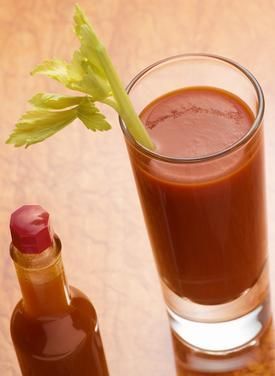
Bloody MaryToday is National Bloody Mary Day.  I can only speculate as to why the first day of the year was chosen to honor to tomatoey cocktail.  Perhaps it has something to do with the idea that New Year's Eve is a heavy drinking holiday, and the Bloody Mary is fabled to be a hangover remedy.

By the way, there's no clinical or scientific evidence to support the anecdotal claim that the Bloody Mary can cure hangovers. Still, the commonly held folk belief and the mass consumption of the beverage by New Year's Eve party goers, awakening the next day, may have made January 1st seem like a natural day to salute the beverage.

-
There's some dispute over the origin of the Bloody Mary. The most widely accepted theory is that it was invented, in 1921, at one of Ernest Hemingway's favorite haunts in Paris, Harry's New York.  Supposedly, when bartender, Fernand Petiot, first mixed vodka with tomato juice the concoction reminded him a girl name Mary, whom he'd known at the Bucket of Blood Club in Chicago.  Thus, it was given the name Bloody Mary.

However, others maintain the cocktail n question was invented 9 years later by comedian George Jessel, who frequented the 21 Club.  Some Epicurean historians have reconciled the two theories by claiming Petiot's drink was merely a combination of vodka & tomato juice, but it was Jessel who came along later and added the seasonings & celery garnish, making it the drink we know today.

No matter what you believe about its beginnings, the fact remains that this spicy fresh tasting vitamin rich cocktail, along with it crunchy stalk of palette cooling celery, has become a mainstay at countless bars, clubs, and parties.  Of course, over the decades numerous variations have emerged, including, but certainly not limited to some of the following recipes.

A Bacon Bloody Mary

A Dirty Sriracha Bloody Mary

A Cajun Bloody Mary

A Beer Based Bloody Mary  (My friend Michael H. drinks these, but with V8 juice, and swears by them.)

A Sweet Basil Bloody Mary 

Like I said though, in a recent pizza review, I prefer mine to be made as follows.
-
Bloody Mary Recipe

This is just the way I like it.

Ingredients:
  • 3 oz tomato juice
  • 1 1/2 oz vodka
  • 1/2 oz lemon juice
  • 1 dash of Worcestershire sauce (optional)
  • celery salt
  • 2 dashes Tabasco sauce
  • celery stalk for garnish
Preparation:
  • Coat the rim of rim of a highball glass with celery salt
  • Build the first 3 liquid ingredients in glass over ice cubes
  • Add Tabasco & Worcestershire sauces & stir well
  • Garnish with celery
-
Whether you like yours smoky, spicy, hoppy, sweet, or traditional, there's undoubtedly a Bloody Mary out there somewhere with your name on  it.   Bottoms up! :-)

Bloody Mary recipe prints individually as page 3 for your fridge or recipe file.
-